| Law Professors
Examine Ethical Controversies of Peer-to-Peer File Sharing
The practice of peer-to-peer file sharing has reached a crossroads
and has the potential to take off as an increasingly popular
and vital method of sharing information. Or it could collapse
under the weight of its own controversy as lawyers and politicians
try to negotiate the intricacies of copyright protections
and the legality of certain file-sharing networks.
That was the message put forward by Law Professor Larry Lessig,
founder of Stanford’s Center
for Internet and Society, during a panel on March 8 on
the ethics of peer-to-peer file sharing. Lessig was joined
on the panel by Law Professor Deborah Rhode, founder of the
Stanford Center on Ethics.
File-sharing technology is expanding in creative and intriguing
ways that could allow an almost limitless ability to obtain
and manipulate just about any kind of electronic content and
then redistribute it. But that technology is threatened by
the recording industry’s stepped-up efforts to crack
down on illegal file-sharing networks and individuals who
engage in such practices, Lessig said. He said the recording
industry is engaged in a war of prohibition with escalating
penalties and has put too much emphasis on stigmatizing those
who engage in illegal downloads as criminals.
“Should the legal system take the lead in shutting
down this kind of communication?” Lessig asked. “Historically,
we have taken this [kind of public debate] much more slowly
and not labeled the other side criminal.”
An estimated 70 million people engage in online file sharing,
much of it illegal. Illegal downloading, mostly of music,
took off in the late 1990s with the popularity of file-sharing
programs like Napster and Kazaa. But the backlash has been
intense, with the Recording Industry Association of America
(RIAA) successfully suing file-sharing networks and bringing
much-publicized lawsuits against individuals accused of illegal
downloading.
By engaging in downloads that they know are illegal, many
people have made themselves magnets for the lawsuits, Lessig
said. Rhode cited a survey of 16- to 28-year-olds who engage
in illegal downloading that showed that although most were
aware that they were engaging in illegal behavior, only 16
percent considered their actions morally wrong. She said her
teenage nephew, when asked about the subject, told her, “Well,
there’s illegal and then there’s illegal.”
Within the past couple of years, the recording industry has
dedicated considerable resources to cracking down on file-sharing
networks and has filed suit against many large-scale and individual
programmers, prompting many to settle their cases rather than
engage in a costly legal battle against an opponent with deep
pockets, Lessig said. Some of the lawsuits would almost surely
fail a legal challenge, he said, but the intimidation factor
has stifled development of file-sharing techniques that could
actually benefit the recording industry.
“What is the RIAA doing aside from suing people?”
Lessig asked. “It’s an industry organization trying
to use the law to protect themselves against competition.”
Lessig said the industry should explore other kinds of file-sharing
platforms and models that would be easier for consumers to
use—and pay for—and that would also set up a better
structure for artists to receive a cut of the profits. He
cited a Harvard study that proposed a tracking system similar
to the Nielsen television ratings system that would make as
much music available at a cost to consumers and then pay artists
based on their popularity.
Lessig said copyright laws that were created more than 25
years ago—long before anyone had a sense of recent technological
advances that allow mass manipulation and redistribution of
online content—are in dire need of an overhaul. He didn’t
advocate doing away with copyright laws altogether, but he
expressed support for loosening up the rules to allow for
“private, noncommercial ventures.”
“All of the great technologies coming out now are technologies
that will allow people to do stuff with your stuff,”
Lessig said. “That’s an extraordinary opportunity
that we should allow our culture to take. We wouldn’t
produce the same laws had we known about the technological
advances.”
— Ray Delgado
|
|
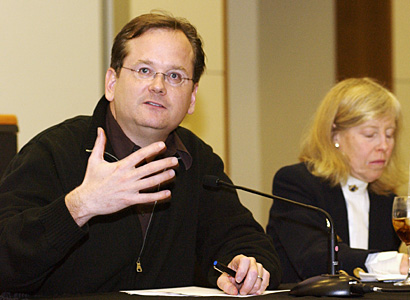
Innovation in file-sharing technology
is threatened by the recording industry’s stepped-up
crackdown, according to law Professor Larry Lessig, who spoke
last week on a panel with law Professor Deborah Rhode. Lessig
expressed support for loosening copyright rules for “private,
non-commercial ventures.”
Photo: L.A. Cicero
This article first appeared
in the March 17, 2004 issue of Stanford
Report. An audio recording of the CIS panel discussion
can be found at http://cyberlaw.stanford.edu/events/past_index.shtml.
|
